
Creating winning project proposals and pricing your services accurately are essential skills for any service-based business.
From crafting a persuasive pitch to mastering effective project estimation techniques, this guide addresses every one of the essentials of proposal writing, pricing strategies, and cost estimation to help you close more deals and drive profitability for your services.
The Foundation of a Winning Project Proposal
A great project proposal serves as a first impression for your prospects and a roadmap for project success. As a baseline, these are the key elements every proposal should include.
Understanding of Client Needs
Start by thoroughly researching your client’s goals, challenges, and expectations. Tailoring your proposal to their specific needs sets you apart from competitors.
Clear Scope of Work
Define the deliverables, timelines, and responsibilities in detail. Ambiguity can lead to misaligned expectations, so be clear and up-front about the expectations from the beginning through your proposal.
Results-Driven Approach
Highlight the value your services bring throughout your proposal. Showcase your understanding of the project’s objectives and outline your plan to achieve the results your client needs.
Professional Presentation
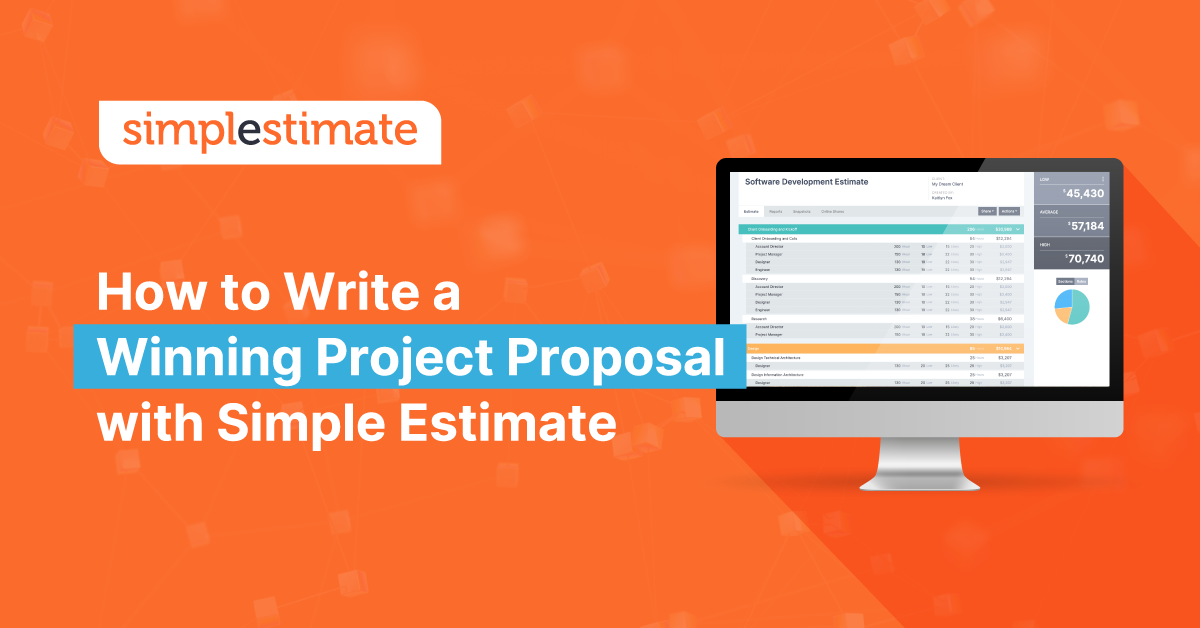
A clean, polished format for your proposal demonstrates your attention to detail. Using tools like Simple Estimate allows you to craft a proposal that reflects your brand and professionalism.
How to Write a Winning Proposal
Proposal writing is a skill all its own, and one that requires careful crafting if you want to show the true breadth of your team’s expertise.
Keep these best practices in mind for every project proposal you create:
- Engage with a strong introduction: Start with an executive summary that captures the client’s interest and provides an overview of your approach.
- Leverage proof: Include testimonials, case studies, or examples of similar projects you’ve previously done to build trust.
- Include a call-to-action: Conclude with clear next steps, such as scheduling a follow-up meeting or signing a contract.
Since no two projects are completely identical, crafting each proposal to address each project’s specific needs is also important. Never let it be a last-minute development that leaves your team scrambling to submit hours before the deadline—even if you have a template you use as a baseline.
Project Estimation Methods for Accurate Pricing
Pricing your services requires a combination of experience, data, and proven project estimation methods. While not every estimation method is created equal, each one has its place depending on your industry and the type of work you do.
Top-Down Estimation
You start with this method by estimating the project’s overall cost and then breaking it down into individual components. This method is useful for straightforward projects with a defined scope and timeline.
Bottom-Up Estimation
Build your estimate by calculating the costs of individual tasks and summing them up. It’s detailed and time-intensive but offers a higher degree of accuracy.
Three-Point Estimation
Using the PERT formula, combine the optimistic, pessimistic, and most likely cost estimates for a more balanced approach. This is one of the most effective project estimation techniques for complex or uncertain projects because it accounts for multiple possible outcomes and risks with your project.
Analogous Estimation
Analogous estimation uses data from similar past projects to estimate costs for new ones. This method is an excellent way to get a quick estimate to include with your proposal, but it works best when historical data closely matches the current project.
Cost Estimation Techniques: Getting Your Pricing Right
Pricing involves more than just covering costs—it’s about creating value while staying competitive. Apply these cost estimation techniques to balance affordability and profitability:
- Time and materials (T&M): Calculate based on hours worked and materials used, ensuring transparency for the client.
- Fixed price: Offer a set price for the entire project, ideal for clearly defined scopes.
- Value-based pricing: Price your services based on the client’s perceived value of the results you’ll deliver.
Streamline Your Process with Project Estimation Tools
While spreadsheets can get the job done, leveraging dedicated project estimation tools like Simple Estimate will save you time, improve accuracy, and help you win more business. Features like customizable templates, revision history, and shareable quotes simplify every step of your quoting process.
Make Simple Estimate Your Tool of Choice
Mastering proposal writing, pricing strategies, and effective project estimation methods are the keys to growing your service-based business. By combining thoughtful client engagement with accurate cost estimation techniques, you’ll stand out in your industry and consistently win projects.Ready to upgrade your estimation process? Explore Simple Estimate’s intuitive platform and take the guesswork out of quoting today.

